
I may have missed the foundational era of anti-corruption advocacy in the 1970s and 1990s, but I have been fortunate to witness – and to contribute at the global level to – the most decisive phase today: the professionalization of anti-corruption, driven by the emergence of a new generation of governance tools and international ISO standards.
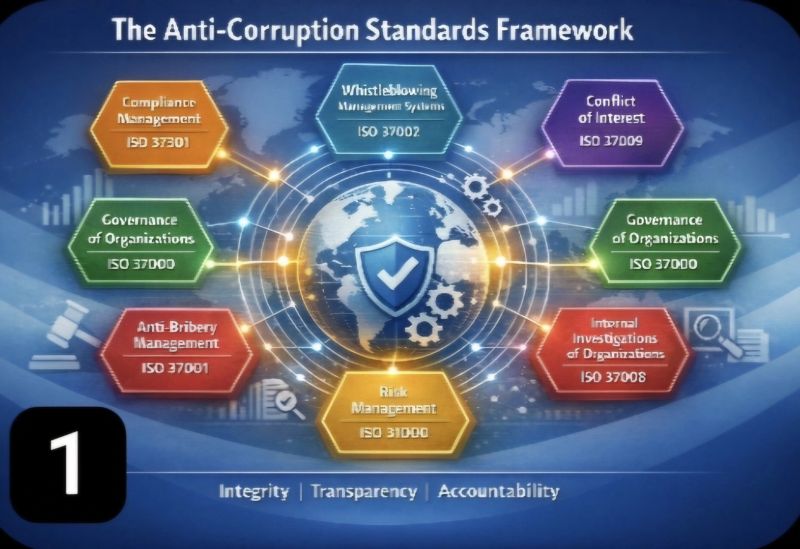
After decades of advocacy and the predominance of enforcement and legal approaches, the fight against corruption has entered a new era marked by the adoption of a number of ISO Management Standards as effective tools to address corruption, such as ISO 37001 Anti-Bribery Management Systems and ISO 37301 Compliance Management Systems, as well as standards on whistleblowing, governance, risk management, fraud and the most recent one, ISO 37009, Conflict of Interest Management Systems. Only the future will tell how effective these standards will ultimately be in addressing corruption. For the time being, these tools are still not valued at their true worth.
Standards, the powerful engine of growth
The history of industry and economic development teaches us that standards have been a powerful engine for growth and reliability. Through their ability to transform complex problems into manageable risks, standards allow organizations to address them through systemic and structured approaches.
By providing common frameworks, clear procedures and measurable practices, standards help organizations navigate multiple challenges while improving governance, accountability and transparency.
It is standards that have made air transportation one of the safest industries in the world, and it is standards that have helped to drastically reduce workplace fatalities and accidents. The revolution in quality management owes much of its success to standardization, particularly with the adoption of ISO 9001 Quality Management Systems.
Standardization has transformed many sectors – environmental protection, medicine, pharmaceutical industry, manufacturing and global trade – by creating shared frameworks that improve efficiency, safety and trust.
The question today is whether, with the adoption of a growing number of ISO standards, standardization will have the same transformative effect in curbing corruption as it has had in other sectors.
The ISO model is aligned with anti-corruption requirements
To what extent can a complex phenomenon like corruption – with its multiple social, moral, political, economic and legal dimensions – be effectively addressed through technical management standards?
This question raises an important debate: whether standardization can move anti-corruption from a reactive model based mainly on enforcement to a preventive and systemic approach embedded in organizational management.
I personally believe that the impact will be significant, based on emerging empirical studies and on the results observed so far within corporations that have implemented ISO 37001 Anti-Bribery Management Systems. In-depth analyses also show the strong alignment between the ISO High Level Structure (HLS) model and the core requirements of effective anti-corruption systems, such as leadership commitment, a risk-based approach, strong internal controls, and auditing, awareness and training.
Standards encapsulate best practices and provide organizations with structured frameworks that enable them to institutionalize integrity and embed anti-corruption principles into everyday management practices.
Kamel Ayadi
Mr. Ayadi is a leading international consultant and civil society activist in the fields of anti-corruption, ethics, governance, corporate social responsibility, and social accountability. He has served in a number of high-level positions, including Tunisian Minister of Public Service, Governance, and Anti-corruption; Chair of the Authority on Financial and Administrative Control; Secretary of State; Senator; and Chair of the Regulatory Authority of Telecommunication.